
Eight Angles, One Open House, and Double the RSVPs
A New York community college needed more of its county in the room. Eight angles replaced one general invitation, every one of them came in under the education category median on cost per registration, and the college reported RSVPs at more than double the prior year.
Quick Snapshot
Sector
Higher Education, Community College
Timeline
25 Days
Primary Bottleneck
One general invitation to a county of very different lives
Core Result
RSVPs More Than Doubled
Efficiency Metric
Every Angle Under the Category Median
Visual Proof
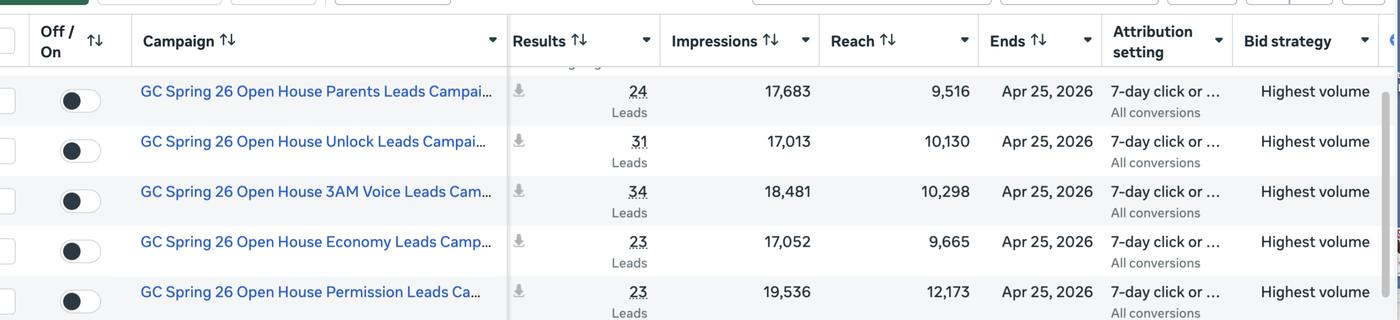
Meta Ads Manager, 1 to 25 April 2026. Five audience angles, 135 registrations. Cost columns withheld at the client’s preference.
The Problem
One Open House. A County With No Single Reason to Attend.
A community college open house draws from lives that have almost nothing in common. A parent worried about where their teenager lands. Someone laid off at forty-five. Someone working nights who assumes a schedule like theirs disqualifies them. Someone who was told a long time ago that college was not for people like them.
Previous cycles ran what most institutions run: one general invitation, in an institutional voice, to all of them at once.
An open house is also the hardest ask in enrollment marketing. Not a download, not a form. A specific building, on a specific Saturday, in a narrow local geography with a small addressable audience. It is the most expensive kind of yes there is to buy.
What We Changed
We Stopped Sending One Invitation to Eight Different People
Eight Angles, Not One Message
Each angle spoke to one reason a specific person might come, and to the specific doubt that would stop them. Same event, eight entry points, running side by side under identical measurement.
Objection First, Institution Second
The copy addressed the fear before the invitation. Not “you cannot afford it, you are wrong,” but someone saying out loud that they did not think they could afford it either. You handle the objection without ever naming it.
Reminders That Escalated Toward the Date
Email frequency increased across the final three days rather than staying flat. The first send opened at 37% and clicked through at 5.3%. The gap between saying yes and showing up is where events are lost, and it is a timing problem as much as a messaging one.
The Result
Eight Angles In. Every One Under the Category Median.
135 registrations in 25 days, and RSVPs the college reported at more than double the prior year.
RSVPs More Than Doubled
The college’s own figure, stated by its chief marketing officer on a recorded status call two days after the event. Not a modelled number and not ours.
Every Angle Beat the Benchmark
All five lead-form angles came in under the education category median for cost per lead. The strongest was roughly a third cheaper than the weakest, on near-identical budgets.
135 Registrations, Plus the Traffic
Five lead-form angles produced 135 registrations. Three further angles drove 2,860 landing page visits into the same event over the same 25 days.
Why It Worked
Nobody Attends a Category. They Attend for Their Own Reason.
The institutional instinct is to describe the event. Programs offered, times, parking. That copy is accurate and it persuades nobody, because it answers a question no one was asking.
What moved people was watching someone who sounded like them say the thing they had been thinking. Not the college explaining that tuition is affordable, but a person saying they did not think they could afford it either.
Segment the Reason, Not Just the Audience
Eight angles against one event. Every one landed under the category median, which is not what happens when you split a budget eight ways for the sake of it.
The Best Click Rate Was Not the Best Result
The angle with the highest click-through produced fewer registrations than two angles that were clicked less. Optimizing on the metric that is easiest to see is how campaigns quietly go wrong.
Escalate Toward the Date
Flat reminder cadence treats a Tuesday three weeks out the same as the night before. It is not the same, and the sequence was built to know that.
The Part That Did Not Improve
RSVPs more than doubled but attendance rose only modestly, because the prior year drew walk-ins this one did not repeat. Demand was solved. Turning a yes into a Saturday morning is a separate problem, and the next fix is capturing attribution at the point of RSVP.
Relevant services used
Generate Demand
Audience Angle Development
One event, several distinct reasons to attend, written separately.
Meta Ad Campaigns
Campaigns measured on cost per registration, not cost per click.
Objection-Led Creative
Video and static built around the doubt that keeps someone home.
Convert Demand
Lead Form and Landing Page Builds
Two routes into the same event, measured against each other.
Split Testing
Competing angles run head to head under identical measurement.
Campaign Optimization
Ongoing refinement of cost, quality and engagement.
Protect Demand
Escalating Reminder Sequences
Email timed to the gap between registering and attending.
Attribution and Tracking
UTM and analytics tracking so the next cycle knows what worked.
Retargeting
Additional proof for people who showed interest but did not register.
I do not name clients publicly. Every figure on this page comes from an ad account, and full screenshots are available under NDA on request.
Figures taken directly from Meta Ads Manager, 1 to 25 April 2026, covering the eight open house campaigns for one community college account. Five lead-form campaigns produced 135 registrations across 89,765 impressions; three traffic campaigns produced 2,860 landing page views across 95,803 impressions. Campaign spend was reconciled against total account spend for the same window to confirm no other campaign promoted the event. Spend, budget and cost per result are withheld at the client’s preference; cost comparisons are stated against the education category median cost per lead published by Superads for September 2025 to September 2026. The RSVP comparison and the prior year attendance figure are the college’s own, stated by its chief marketing officer on a recorded status call on 30 April 2026 and described by him as approximate. Attendance rose modestly year over year rather than in proportion to RSVPs; the prior cycle drew walk-in attendance beyond its RSVP count which this cycle did not repeat. Email metrics from the campaign platform.
Filling a Room Is Harder Than Filling a Form
I fill scheduled events. Open houses, webinars, tours and appointments. Getting a stranger to commit to being somewhere at a particular time is a harder problem than collecting an email address, and it is the one I have spent my career on.
“If one message is doing the work of eight, the cheapest thing you can change is how many people you are willing to talk to separately.”